How to use this archive ?
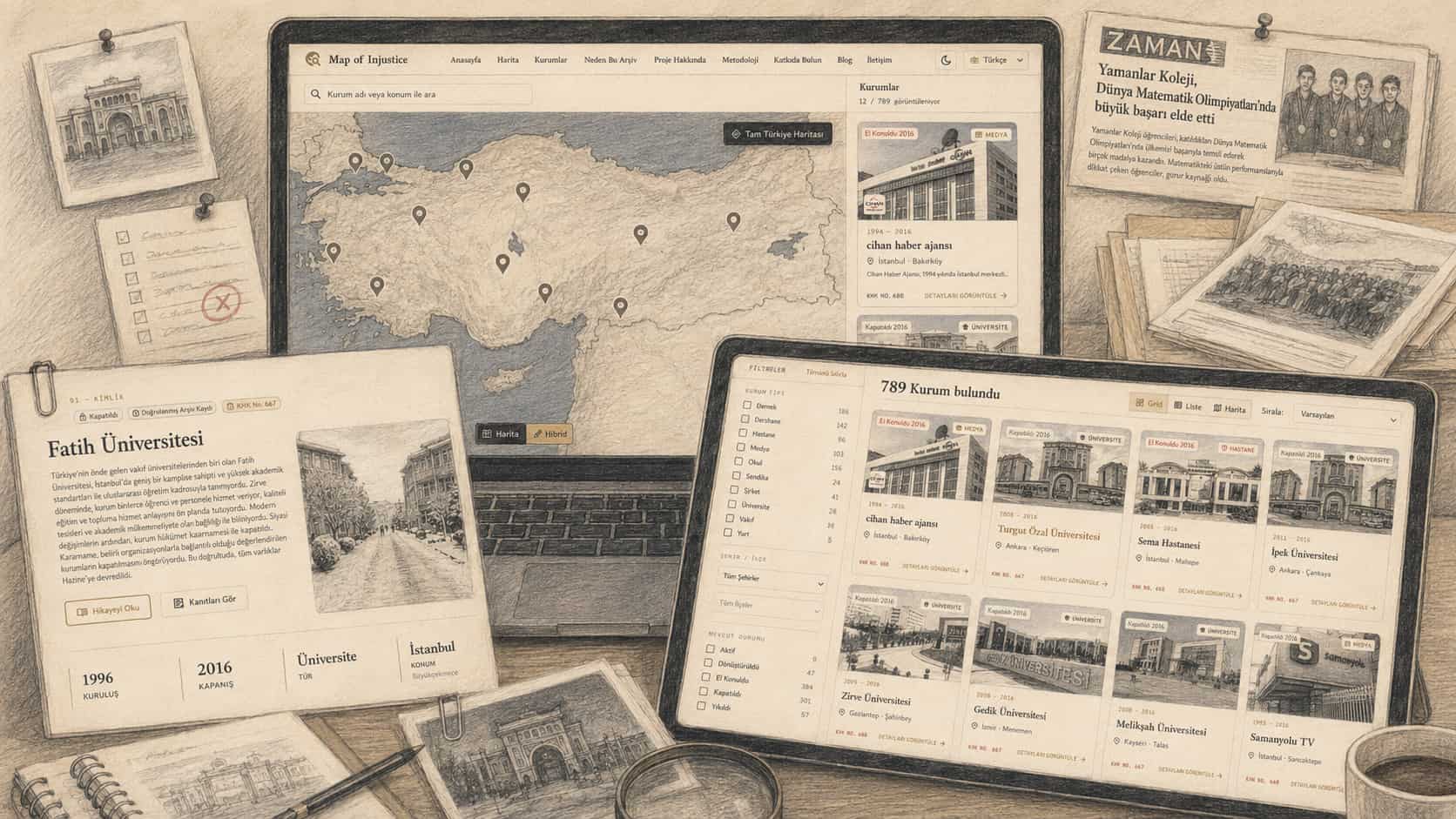
From the homepage to the map, from the institution records to the data table: let us walk through every door of the archive together.
There is no single way to read this archive. Whether you are a researcher, a journalist, a former student or simply a curious visitor, there is a starting point that suits you. Below we introduce each of the archive's doors in turn.
Homepage
The homepage is a brief summary of the archive. Here you will find the headline figures, such as the total number of records, the institution types and the number of affected cities; a live glimpse of the map; a few featured institutions; and a selection of testimonies shared by the community. If you are not sure where to begin, the homepage is a good compass.
The Map
The map page shows the closed institutions across the geography. Every institution type has its own marker; universities, schools, hospitals, associations, foundations and media outlets are distinguished by different symbols. Records that are close together are gathered into a single cluster and open up one by one as you zoom in.
When you click a marker, the institution's name, type and date range appear in a small card, from which you can go to the institution's own page. You can filter the map by province, district and institution type, and find an institution directly with the search box. The map and the list beside it are linked: the area you browse on the map is the area the list shows.
Institutions
The institutions page is the catalogue of every record in the archive. You can view the records in a card or a list layout.
Here too you can filter by province, district and institution type, and find an institution directly with the search box. The archive holds ten institution types: university, school, tutoring centre, dormitory, hospital, association, foundation, media outlet, company and other. Because there are many records, the list is divided into pages.
Institution Pages
Each institution's page is conceived as a dossier. A timeline reaching from its founding to its closure, images, news and document sources, snapshots taken from the web archive, and, where available, testimonies shared by those connected to the institution all come together on these pages. The aim is to gather scattered fragments into a single account.
The Data Registry
For those who want to see the whole behind the numbers, the Data Registry section presents all the records as a table. You can sort, filter and export the list. This section was prepared with academic researchers and those who wish to use the data in their own analysis in mind.
Contribute
The archive is not the work of a single team. On the Contribute page we accept four kinds of contribution: you can propose an institution that is not yet in the archive, report an error in an existing record, share your testimony about an institution, or add a news or document source. Every contribution is reviewed by our team before it is published.
The background of the archive
Some pages describe not the institution records but the archive itself. The Why This Archive page explains why this work was needed, the Methodology page explains the steps by which records are verified, and the About page tells who runs the archive. Whenever you have a question, a suggestion or a correction, you can reach us through the Contact page. We added these pages so that the archive remains transparent and accountable.
In ten languages
The content of the archive is offered in ten languages. You can switch to the language you prefer from the language option at the top of the page. Our aim is for these records to be reachable not only from within this country but by researchers and readers everywhere in the world.
Our aim
Our aim is clear: to preserve the memory of the closed institutions as a verified, accessible and lasting resource. This archive is not a finished book but a notebook that grows together with us. Every new record, every testimony, is a note held against erasure.